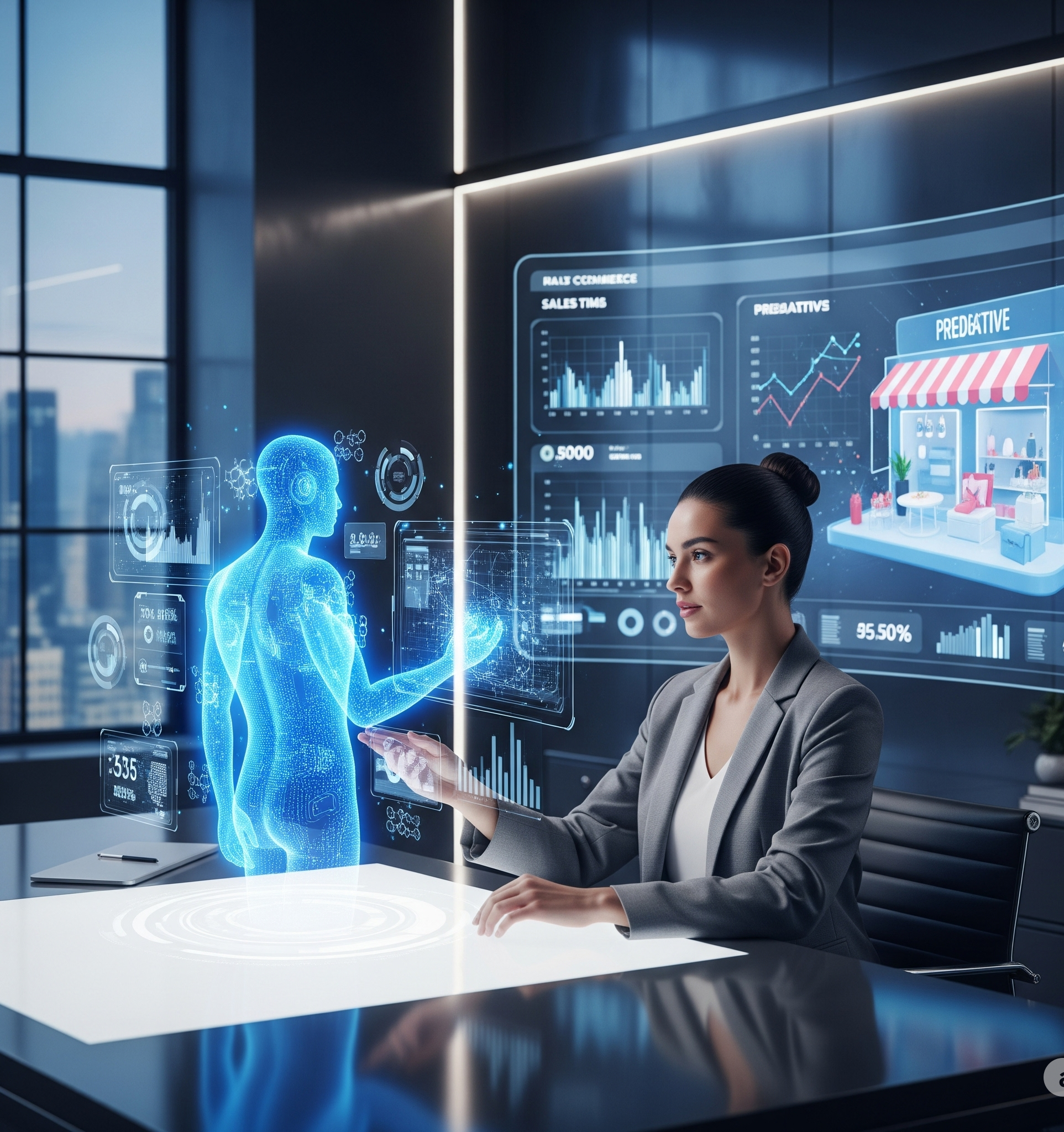
Artificial intelligence (AI) is no longer science fiction for eCommerce businesses. It has moved from being a futuristic concept to an efficient and indispensable business tool. By 2025, AI in eCommerce is reshaping strategies and transforming consumer experiences, making it one of the fastest-growing areas of technology.
Businesses are leveraging AI to anticipate customer needs, improve operations, and gain a competitive edge. From personalized shopping to fraud detection, AI’s potential in eCommerce is boundless.
This article dives deep into how AI is revolutionizing eCommerce strategies, explores its vital applications, and provides actionable insights to help you thrive in this AI-driven era.
Understanding AI in eCommerce
AI refers to the simulation of human intelligence in machines programmed to perform cognitive tasks like learning, decision-making, and problem-solving. In eCommerce, AI leverages algorithms to process large datasets, enabling businesses to optimize almost every aspect of their operation.
Key AI Technologies Used in eCommerce
- Machine Learning: Powers predictive analytics for understanding customer behavior and demand forecasting.
- Natural Language Processing (NLP): Enhances user experiences via AI chatbots and voice search accuracy.
- Image Recognition: Allows search results and recommendations based on uploaded images.
- Recommendation Engines: Provides personalized product suggestions by analyzing customer data.
At its core, AI in eCommerce simplifies complex operations, helping businesses adapt to dynamic consumer needs while staying competitive.
AI-Powered Personalization
Personalization has become a consumer expectation, not a luxury. AI takes personalization to a whole new level by analyzing customer behavior, purchase history, and browsing patterns. This allows businesses to tailor experiences to individuals effortlessly.
The Role of AI in Personalized Shopping
AI enables hyper-personalized shopping experiences by:
- Offering real-time product recommendations based on current browsing.
- Customizing discounts based on purchasing habits.
- Email marketing tailored to individual preferences.
Example: Amazon’s recommendation engine, powered by AI, generates 35% of its revenue by suggesting items based on user behavior.
With AI, personalization becomes scalable, enabling businesses of all sizes to deliver meaningful customer experiences.
Enhanced Customer Service with AI
Strong customer service can build loyalty, and AI innovations are setting new benchmarks for support efficiency.
AI Chatbots for Instant Support
AI-powered chatbots handle customer queries 24/7, providing instant replies. NLP ensures the bots understand a wide range of human queries, even complex or context-heavy ones.
Real Benefits:
- Faster response times.
- Reduced reliance on human agents for repetitive tasks.
- Consistency in service quality.
Example: H&M uses AI chatbots to help customers locate products, track orders, and find store locations, ensuring a seamless experience.
AI also identifies common support issues, allowing businesses to address them proactively for smoother customer experiences.
AI in Supply Chain Management
Supply chain logistics can be a nightmare without accurate demand predictions and inventory management. AI eliminates this chaos by optimizing supply chain operations.
How AI Optimizes Supply Chains
- Demand Forecasting: Machine learning models predict demand trends, preventing overstocking or inventory shortages.
- Route Optimization: Enhances delivery efficiency by suggesting optimal logistics paths.
- Operational Transparency: Provides real-time insights into supply chain processes.
Example: Walmart leverages AI to predict sales patterns and manage inventory effectively, reducing carrying costs and ensuring product availability in high-demand periods.
AI transforms supply chains from a back-end operation into a strategic advantage, improving speed and resource allocation.
AI for Fraud Detection and Security
Fraud poses a significant threat to online retail, but AI’s ability to identify unusual transaction patterns is bolstering security measures.
Fighting Fraud with AI
- Monitors billions of transactions for suspicious activities in real time.
- Flags anomalies, such as unusual purchase locations or abnormally large order volumes.
- Enhances payment security using predictive and behavioral analytics.
Example: PayPal uses AI systems to analyze millions of transactions, achieving a high fraud detection accuracy rate without hindering genuine transactions.
Robust fraud prevention builds trust and ensures secure customer interactions, a critical factor for eCommerce success.
Improving Marketing Strategies with AI

Marketing is where AI’s impact often shines the brightest. Its ability to analyze, automate, and predict gives businesses an edge in reaching the right audience with the right message.
AI’s Impact on Marketing
- Ad Targeting: AI optimizes ad placements by analyzing user preferences and behaviors.
- Content Generation: AI tools craft captivating ad copy, blogs, and social media posts in seconds.
- Consumer Behavior Analysis: AI tools like Jasper predict upcoming trends, enabling businesses to align marketing strategies accordingly.
Example: Coca-Cola uses AI-driven marketing to analyze customer engagement and craft personalized campaigns that increase returns.
Marketing powered by AI ensures a higher ROI by minimizing wasted spend and maximizing message effectiveness.
Real-World Success Stories
Nothing showcases AI’s potential like real-world applications. Here are a few businesses that have harnessed AI effectively:
1. Stitch Fix: Uses AI algorithms for styling to suggest apparel tailored to individual tastes, reducing returns.
2. Alibaba: Employs AI to manage smart logistics, enabling same-day delivery for their customers.
3. Sephora: Utilizes AI for virtual try-ons and personalized skincare suggestions, delivering unique shopping experiences.
These success stories highlight the possibilities AI offers when integrated intelligently into eCommerce strategies.
Challenges and Considerations
AI adoption is not without hurdles. Common challenges include:
- High Initial Investment: Building AI infrastructure can be costly.
- Data Privacy Concerns: Ensuring sensitive customer information is protected is critical.
- Skill Gaps: Companies may lack the expertise needed to implement AI solutions.
Strategies like outsourcing initial AI deployments or leveraging cloud-based AI platforms can address these concerns effectively.
Future Trends in AI and eCommerce
By 2025, here’s what eCommerce businesses can expect to see from AI:
- Voice Commerce Boom: More consumers will use voice search for purchases.
- Sustainability and AI: AI-powered tools will help businesses adopt greener practices, such as eco-friendly logistics.
- Augmented Shopping Experiences: Virtual fitting rooms and AR-powered try-before-you-buy solutions will become commonplace.
Staying ahead of these trends will be essential to remaining competitive in the evolving business landscape.
People Also Ask
Q. What is AI in eCommerce?
AI in eCommerce refers to the use of artificial intelligence technologies to enhance and streamline online retail operations.
Q. How does AI help in personalized shopping?
AI analyzes customer data such as browsing history and preferences to provide recommendations tailored to individual tastes.
Q. What are some examples of AI in marketing?
AI assists in ad targeting, consumer behavior analysis, and automating content creation for streamlined marketing efforts.
FAQ Section
What are the benefits of AI in eCommerce?
AI improves efficiency, personalizes customer experiences, enhances security, and strengthens marketing strategies.
How expensive is AI implementation for eCommerce businesses?
Costs vary, but cloud-based services and pre-trained models make AI increasingly affordable for businesses of all sizes.
Are there ethical concerns with AI in eCommerce?
Yes, concerns include data privacy, bias in algorithms, and potential misuse. Addressing these involves adopting transparent and ethical AI practices.
Unlock AI for Your eCommerce Business
AI is no longer a luxury for eCommerce businesses; it’s a necessity. By adopting AI now, you can revolutionize your strategies, improve customer experiences, and maximize ROI.
If you’re ready to stay ahead in the AI revolution, start exploring AI solutions tailored for your business today.